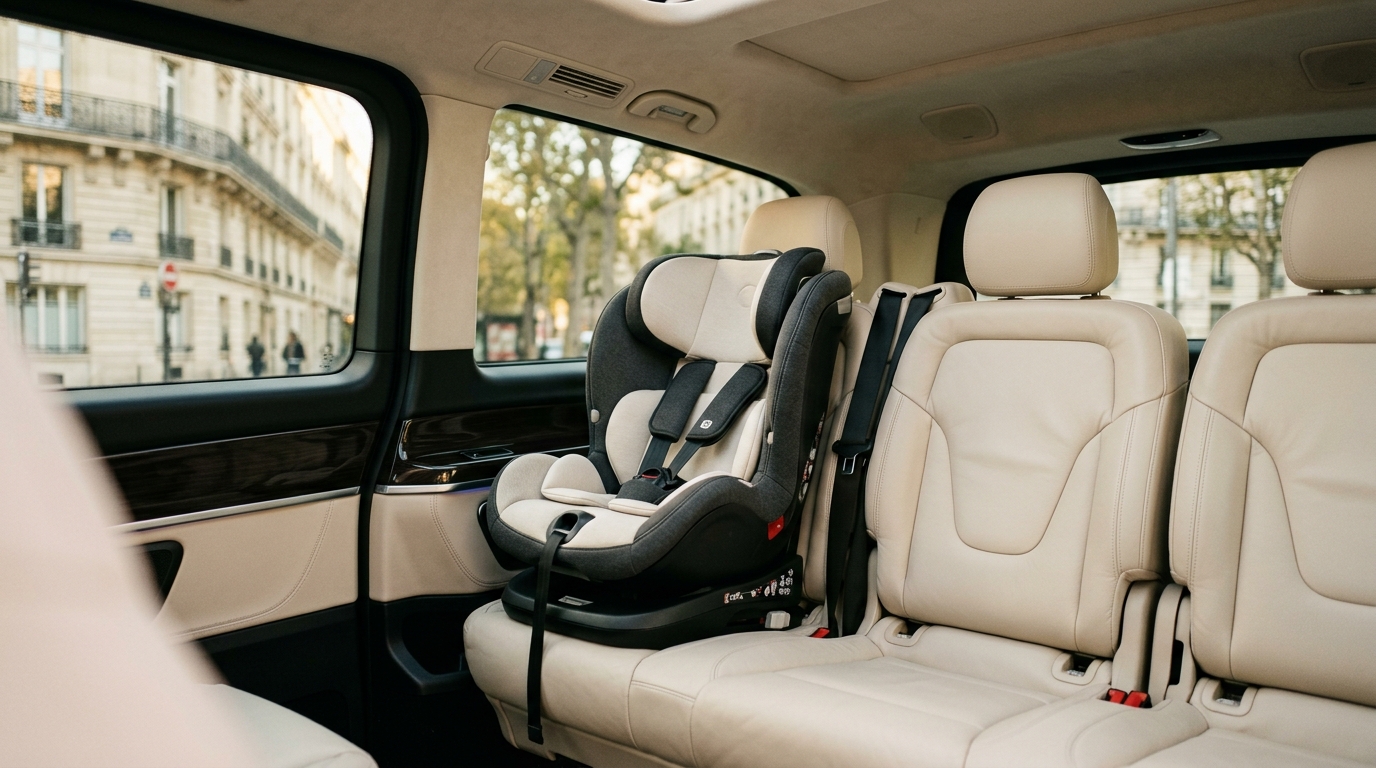
A family landing at Charles de Gaulle with two small children will, in the vast majority of cases, get into a car where no child seat is waiting for them. This is not an isolated lapse. It is the direct consequence of a French rule almost no visitor knows: taxis are exempt from the child restraint requirement, and private hire vehicles are not. This guide sets out what the law says, which seat each age needs, and how to arrive with everything already fitted.
I.What French law actually says
The governing text is article R412-2 of the French highway code (code de la route). It sets out a general obligation, then lists exhaustively the exemptions. Both halves matter, because the second creates all the confusion.
The obligation: in a motor vehicle with no more than nine seats, every child under ten years old must be restrained by an approved child restraint system suited to their build and their weight. That covers the family car, a rental car, and a chauffeured car booked in advance.
The exemptions, set out in section III of the article, number three:
- a child whose build already suits the adult seat belt;
- a child holding a medical exemption certificate, with its validity period stated on it;
- a child carried in a taxi or in a public transport vehicle.
Breaching the rule is a fourth-class offence: a €135 fixed fine (€90 if paid promptly, €375 if late) and three penalty points off the licence. The driver is the one fined, because he is the one at the wheel.
II.Taxi or private hire: the distinction nobody explains
The third exemption names two precise categories, and only two: the taxi and the public transport vehicle. A private hire car — a VTC in French, the category Uber, Bolt and every chauffeur company in Paris operates under — is neither.
A taxi is a distinct legal status governed by the French transport code: a parking authorisation issued by the local authority, a fare meter, the right to be hailed in the street, an illuminated roof sign. The exemption exists for a practical reason: a taxi picks up strangers all day and cannot carry every approved seat on the market. Public transport means coaches and buses, where a child seat is beside the point.
A VTC is a chauffeured car booked in advance. Because the journey is known beforehand, the legislator saw no reason to exempt it: the chauffeur knows who he is carrying and can prepare the car. The result is that a private hire car is held to exactly the same standard as a private family car.
Child seats supplied and fitted, no extra charge
CDG or Orly to Paris: from €140 in a Mercedes E-Class, from €160 in a Mercedes V-Class (up to 7 passengers, pushchair and luggage). Tell us the age and height of each child and everything is ready before you land.
Book via WhatsAppHere is the blind spot. An American, British or Middle Eastern family that orders a car from an app on the jet bridge assumes the question is settled, the way it would be in a New York or London cab. They find out at the kerb that there is no seat, at midnight, with two exhausted children and six suitcases. Two ways out, neither of them good: walk away and start hunting for another solution, or get in anyway.
| Criterion | Paris taxi | Ride-hailing app | Booked private chauffeur |
|---|---|---|---|
| Legal exemption from child seats | ✓ Yes (R412-2, III, 3°) | ✗ No | ✗ No |
| Child seat actually on board | ✗ Almost never | ~ Rare, hit and miss option | ✓ Reserved in advance |
| Seat matched to the exact age | ✗ No | ✗ One category only | ✓ Carrier, harness or booster |
| Fitted by the chauffeur | ✗ No | ✗ Down to you | ✓ Installed before you land |
| 7-seat vehicle guaranteed | ✗ Pot luck | ~ Depends on the category booked | ✓ Mercedes V-Class |
| Unfolded pushchair accepted | ✗ Rarely | ✗ Rarely | ✓ V-Class boot |
| Cost of the seats | Not applicable | Surcharge is common | Included, no supplement |
The taxi exemption is not a safety standard. It is an administrative tolerance — and it does not apply to the car you are about to get into.
III.Which seat for which age
Since 1 September 2024, only seats approved under the European R129 standard, known as i-Size, may be sold in the European Union. It replaced the older R44/04 standard, though seats already bought under R44/04 remain legal to use. The difference lies in the reference criterion: R129 classifies restraints by the child's height rather than by weight, and makes rear-facing travel compulsory to at least fifteen months.
The infant carrier
A shell seat installed facing the rear, which spreads the energy of a frontal impact across the whole back and supports the neck — the most vulnerable part of an infant's body. R129 makes this position mandatory until fifteen months are complete, a threshold a great many parents move past too early.
In practice: if the carrier goes in the front, the passenger airbag must be switched off. In a Mercedes V-Class the question never arises, because children travel in the rear.
The five-point harness seat
The harness holds the child at the shoulders, the hips and between the legs. It is the right device for the age range where a child sits up confidently but the skeleton still cannot take an adult belt. Reversible models let you keep a child rear-facing well past fifteen months, which is what road safety bodies recommend.
In practice: a child in a thick coat is not properly strapped in. Take the padded jacket off, tighten the harness, then lay the coat over them. In our vehicles the climate control is set before you arrive for exactly this reason.
The booster seat
Its job is not to raise the child for the view but to place the belt where it belongs: the diagonal strap across the middle of the collarbone rather than the neck, the lap strap on the pelvic bone rather than the abdomen. The backrest adds a belt guide and side impact protection that a backless booster cushion cannot offer.
In practice: French law fixes the limit at ten years old. The useful marker is height: it is at around 135 cm that an adult belt starts to sit correctly on its own. A small nine-year-old still needs a booster.
IV.How to book a transfer with seats fitted
At FAIZ TRANSPORT PARIS, child restraints are supplied and fitted at no extra charge. The one condition is that you tell us when you book, because a seat cannot be improvised: it has to be taken out, strapped in and checked for anchorage before you arrive.
Three pieces of information are enough, and they take seconds to send over WhatsApp:
- The age and height of each child. That is what determines the exact category of restraint. "Two children" is not enough: an eight-month-old and a seven-year-old do not need the same seat.
- The number of adults and the volume of luggage. Two child seats eat up bench width, and that is what tips the choice towards a Mercedes V-Class.
- The pushchair model. A folded umbrella stroller and a chassis with a carrycot do not take up the same space, and that difference decides the vehicle.
The chauffeur fits the seats before heading to the terminal. When you come out of customs there is nothing to assemble, nothing to adjust, nothing to negotiate: you sit your children down and you go. On a CDG transfer after a long-haul flight, saving ten minutes standing in a concourse wrestling with a seat belt is not a detail.
V.Why the V-Class is the right answer for a family
The Mercedes E-Class is an excellent transfer car: three passengers, two large cases, saloon comfort. But a family is not three passengers with two suitcases. It is two adults, two children, two bulky seats, a pushchair and everybody's luggage. The V-Class solves three constraints the saloon cannot absorb at the same time.
01.Bench width
Two child seats side by side on a saloon bench leave a middle seat nobody can use: the adult travels wedged between two rigid shells for the whole journey. The V-Class has individual seats across two rows, so you can fit two restraints without sacrificing an adult, and put a parent next to the child who needs one.
02.The boot, not the back seat
In a saloon the pushchair quickly ends up inside the cabin for want of room behind. In a V-Class the boot swallows an unfolded pushchair and three large suitcases without anything migrating on board. The comfort of a family journey depends as much on what is not on your knees as on the quality of the leather.
03.Sliding side doors
Getting a child into a seat needs space above and to the side. The V-Class's sliding doors open without swinging out, which changes everything on a narrow pavement in the 8th arrondissement or in a terminal car park. The roof height lets you step in upright, with a child in your arms.
| Mercedes E-Class — CDG or Orly → Paris 8th | from €140 · up to 3 passengers |
| Mercedes V-Class — CDG or Orly → Paris 8th | from €160 · up to 7 passengers |
| Mercedes S-Class — CDG or Orly → Paris 8th | from €200 · 1 to 2 VIP passengers |
| Child seats and boosters | Supplied and fitted, no supplement |
| Waiting time after landing | 60 minutes included |
| Night, traffic or flight delay surcharge | None |
The gap between the E-Class and the V-Class on an airport transfer is €20. For a family of four with a pushchair, it is probably the best twenty euros of the whole trip. All three vehicles are described in detail on the Our Fleet page.
VI.Pushchairs, suitcases and boot space
This is the most underestimated subject at the moment of booking, and the one that produces the most unpleasant surprises at the boot lid. A few concrete markers:
- Umbrella stroller or folded compact pushchair: fits in the boot of an E-Class alongside two cabin cases or one large suitcase.
- City pushchair with a chassis: folded, it takes up the equivalent of one large suitcase on its own. In an E-Class with two hold bags, it no longer works.
- Double buggy or chassis with carrycot: V-Class, no way around it. The boot takes it without dismantling, so you are not folding and unfolding it at every stop.
- Travel cot, table seat, changing bag: secondary volumes that add up fast. Mention them, they count in the calculation.
- The return leg to the airport: always assume more volume than on the way in. Paris shopping fills an extra suitcase in almost every case.
When the volume goes beyond what one vehicle can take, a follow car can be added: the luggage travels behind, the family travels in comfort. It is a routine request on Orly transfers during school holidays.
VII.Paris with children: real distances and real timings
Parents almost always underestimate journey times in the Paris region, because they think in kilometres. In Paris it is traffic that dictates the clock, and a short hop on the map can take an hour.
| CDG → Paris 8th | 30 km · 35-50 min off-peak, 60-90 min at rush hour |
| Orly → Paris 8th | about 18 km · 30-45 min depending on traffic |
| Paris → Disneyland Paris | about 40 km · 45-60 min |
| Paris → Palace of Versailles | about 22 km · 40-60 min |
| Crossing Paris east to west in daytime | 30 to 50 min for 8 km |
| Hours to avoid with young children | 8-10am and 5-8pm on weekdays |
What tires children out is not the raw length of the drive. It is the accumulation of waiting on their feet: the taxi queue, the pavement, the concourse, the hunt for a car in a car park. A child copes very well with fifty minutes in a seat after a flight; the same child copes far worse with twenty minutes in a line with a backpack on.
Three simple habits make a real difference to a family stay in Paris: group your visits by neighbourhood rather than crossing the city three times in a day; put the longest journey first thing in the morning, while the children are still receptive; and keep the car with you rather than ordering a new ride at every stop, which removes the waiting on the pavement entirely. Our chauffeur at your disposal service exists precisely for this.
VIII.The FAIZ TRANSPORT service for families
FAIZ TRANSPORT PARIS has operated airport transfers daily since 2021, with an all Mercedes-Benz fleet. What we commit to on family journeys:
- Child seats and boosters supplied — infant carrier, harness seat or high-backed booster, no supplement, fitted before you arrive
- Mercedes V-Class — up to 7 passengers, individual seats, sliding doors, a boot that takes an unfolded pushchair
- Real-time flight tracking — the pickup time adjusts automatically to the actual landing
- 60 minutes of waiting included — enough time to collect the bags without running
- Name-board greeting in the arrivals hall and baggage assistance to the vehicle
- Mineral water, chargers and WiFi on board
- Bilingual FR/EN chauffeurs, available 24 hours a day, 7 days a week
- No surcharge for night arrivals, traffic or flight delays — the quoted rate is the rate you pay
For an arrival with children, message us on WhatsApp at +33 7 54 13 92 96 with your flight number, the age of each child and the type of pushchair. Reply in under fifteen minutes, fixed rate confirmed before departure.